You have updated your LinkedIn. You have polished your CV. You have applied on LinkedIn and Indeed, built a portfolio and practised your interview answers. And still, nothing.
All of those things are useful. But they are not what separates the person who keeps applying from the person who actually gets opportunities. This guide is about the second group: what they do differently, and how you can do it too, whether you work in software engineering, data analysis, cybersecurity, product design, AI, product management or another tech discipline.
The whole idea fits in one line:
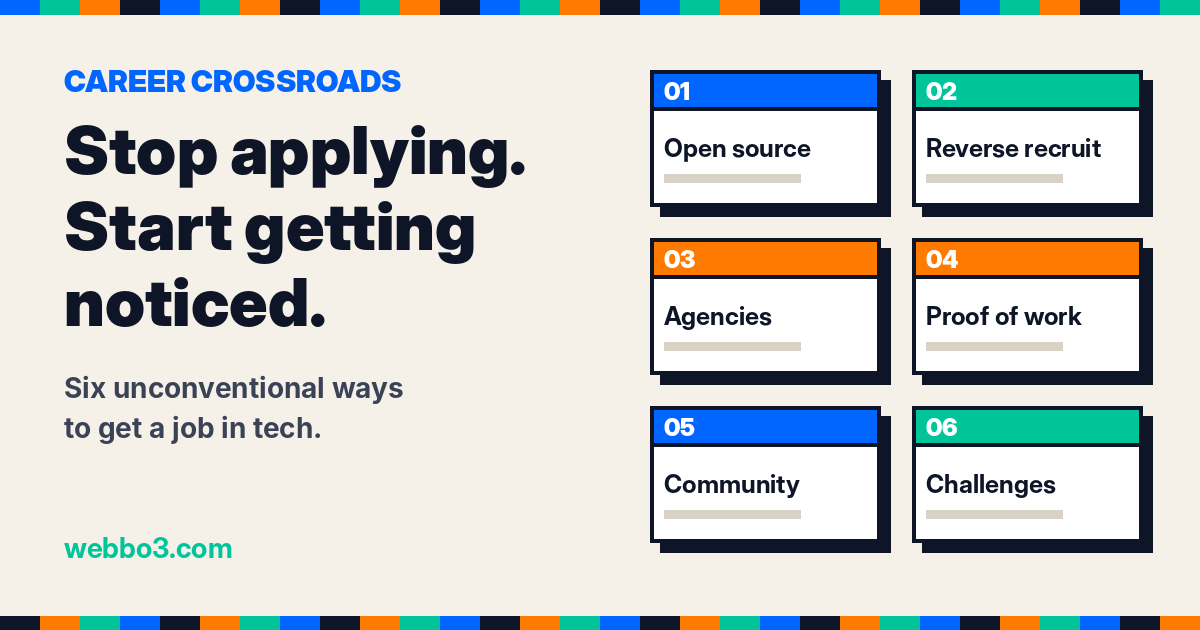
Stop waiting for job vacancies. Start positioning yourself where opportunities are created.
What the research says about getting hired
Before the six strategies, look at what employers actually value. In the Linux Foundation's 2025 Global Tech Talent Report (556 respondents), hiring managers ranked what matters when they hire:
- Relevant hands-on experience: 95%
- Portfolio and previous IT accomplishments: 85%
- Certifications: 71%
- A formal university degree: 65%
That changes how you should hunt for work. It is not enough to tell employers what you know. You need to make them see what you can do.
Two more findings point the same way. The HackerRank 2025 Developer Skills Report found that 74% of the developers it surveyed still struggle to land jobs, and it names open-source contributions, hackathons and community engagement as ways to get noticed. The Built In 2025 Talent Trend Report ranked referrals as the top technology recruitment channel among those it surveyed, at 48.4%.
In other words, many opportunities live outside the normal application process. Here are six ways to reach them.
1. The open-source backdoor
The idea: instead of asking a company to give you a job, become useful to the people building the technology.
Open-source projects are public working environments. You can contribute to software maintained by companies, engineering teams and respected developers around the world, and every contribution is a public, verifiable demonstration of what you can do.
How it works
- Pick a reputable open-source project that uses your technology.
- Explore its GitHub repository.
- Look for issues labelled
good first issue,help wantedor documentation improvements. - Solve a genuine problem.
- Submit a pull request.
- Take part in code reviews and discussions.
- Build relationships with the maintainers and other contributors.
- Show your contributions on your professional profile.
It is not only about code
- Frontend developers can fix accessibility and UI issues.
- Backend developers can fix APIs and improve performance.
- Data analysts can improve datasets, SQL examples and analytical documentation.
- Cybersecurity learners can review security issues through a project's own authorised process.
- Product designers can improve open-source interfaces.
- Technical writers can improve documentation.
Google's technical writing guidance recommends contributing documentation to open-source projects as a way to build a portfolio, and Linux Foundation research reports maintainers who were hired because of their project expertise.
Where to start: GitHub, Good First Issue, First Timers Only, Google Summer of Code and Outreachy.
Try this: find one open-source project, make one meaningful contribution and write up how you did it. The goal is not GitHub stars. It is to become a contributor someone can confidently recommend.
Don't just use technology. Contribute to the technology other people are building.
2. Reverse recruitment: find companies before they advertise
The idea: most job seekers wait for a vacancy. Instead, find a company with a problem you can solve and approach them before any job is posted.
This works especially well with early-stage startups, small businesses and growing tech companies. A startup might need a frontend developer to improve its dashboard, a backend developer to fix slow APIs, a data analyst to understand its customers, a security review, a better onboarding design or an AI automation. It can have the need long before it writes a job advert.
How to do it
- List 20 companies in an industry you understand.
- Use their websites and products properly.
- Find one genuine problem or improvement for each.
- Find the person who decides: the founder, CTO, engineering manager or product manager.
- Write a short, personalised note.
- Show evidence of the problem and how you would solve it.
- Ask for a short conversation, or offer a small paid pilot.
What the difference looks like
Imagine you are a frontend developer and you find a Nigerian fintech startup with a confusing registration process. One person sends:
"Hello sir, I am a frontend developer. Please do you have any job opportunities?"
Another sends:
"Hello, I explored your platform and noticed the registration process could be simpler, especially the onboarding steps. I put together a small demonstration of how the experience could be improved. I'd love to share it with your product team if you're open to it."
The second message starts a conversation about business value. That is the one that gets a reply.
Where to find companies: Y Combinator's company directory, Wellfound, Product Hunt, TechCabal, Techpoint Africa and LinkedIn. A useful trick: browse Product Hunt for newly launched products, study them, spot a gap and write to the founder with a specific improvement.
Try this: find five startups, spot one problem in each, write one personalised message per company with a small piece of evidence or a demo, and track who replies.
Don't wait for a company to announce that it needs you. Find a problem that makes it need your skills.
3. Agency subcontracting
The idea: you don't always need to find clients yourself. Find people who already have clients but need more hands.
Digital marketing agencies, software houses, branding studios, IT consultancies, product studios and independent consultants win projects every week, and many do not have enough people to deliver them all. Instead of competing with them for clients, become someone they can hand work to.
Say an agency wins a contract to build an e-commerce platform. It owns the client relationship but needs two frontend developers, a backend developer, a UI/UX designer and a QA tester. You can join that delivery team without ever finding the original client.
How to do it
- List 30 digital agencies.
- Study their websites, services and past projects.
- Find the services that match your skills.
- Contact the founder, operations manager or project manager.
- Introduce yourself as an available technical delivery partner.
- Share two or three relevant work samples.
- Offer a small paid pilot or a clearly scoped first project.
A message you can adapt
Hello, I came across your agency and noticed that you work on digital product development and web projects. I'm a [your specialisation] with experience in [your key skills]. I'm reaching out to explore supporting your team on projects whenever you need extra technical capacity. I'd be happy to share my portfolio and talk about how I could help your delivery. Thank you.
Where to find agencies: Clutch, DesignRush, LinkedIn, Upwork, and Google Maps (search "digital agency" in your city).
You don't need 100 direct clients. Three reliable agencies that regularly outsource work can be enough.
Try this: find ten agencies, contact five, and put together a short subcontracting portfolio.
Sometimes the easiest way to get clients is to work with someone who already has them.
4. Public proof of work
The idea: stop telling people you are good at something. Keep publishing evidence that shows it.
This is not posting certificates, motivational quotes or screenshots of finished tutorials. It is making your real work easy to find.
A data analyst who posts "I'm a data analyst. I know Excel, SQL and Power BI" says very little. Compare that with: "I analysed a sample Nigerian retail dataset of 10,000 transactions and found that 35% of revenue came from three product categories. Here is the dashboard, the SQL and my business recommendations." That is a much stronger signal.
What to publish, by track
- Software engineering: working applications, architecture decisions and code walkthroughs.
- Data analysis: dashboards, SQL investigations and business insights.
- Cybersecurity: legal lab walkthroughs, CTF write-ups and defensive security research.
- UI/UX: redesigns, user research, prototypes and the reasons behind your choices.
- AI engineering: working automations, AI agents and how you evaluated them.
- Product management: product teardowns, PRDs, prioritisation and product experiments.
The part most people skip: show your thinking
Don't only publish the finished product. Explain the problem you were solving, what you got wrong at first, what you discovered, why you chose your solution and what you would improve. That shows how you think, not just which tools you have touched.
Where to publish: DEV Community, Hashnode, LinkedIn, GitHub, Medium and Behance.
Try this: over 14 days, publish two project demonstrations, two technical lessons learned, one detailed case study and one clear explanation of a problem you solved. You are building a searchable body of evidence.
Your online presence should not just tell people who you are. It should show them what you can do.
5. From community to opportunity
The idea: become a known, useful person inside a professional community before you need a job.
Most people join a tech community and immediately ask, "Who has a job opportunity?" That is the wrong way round. Become known for adding value instead:
- Help others solve technical problems and answer questions in forums.
- Volunteer to organise events, or give a short talk.
- Review other people's projects.
- Help maintain community resources or run study sessions.
- Connect people who can help each other.
Over time, people link your name with competence and reliability. When someone in that community needs a developer, designer, analyst or security professional, you are not a stranger any more. With referrals ranking as the top tech hiring channel, that matters a great deal.
Communities worth exploring: Google Developer Groups, She Code Africa, Ingressive for Good, Stack Overflow and developer communities on Discord.
A less obvious move: be a contributor, not just a member. Offer to teach a 20-minute session at a local meetup, share your slides and project afterwards, and connect with the attendees who work in your target industry. One real relationship can open a door that a hundred applications cannot.
Try this: join two relevant communities, contribute something useful every week, attend one online or in-person industry event, build three genuine professional relationships and follow up with the people you meet.
Don't just enter the room. Become someone people remember when opportunities arise.
6. Challenges, bounties and competitive hiring
The idea: instead of waiting for a normal interview, put yourself where your skills are tested against real problems.
A. Hackathons and innovation challenges
A good hackathon submission shows technical ability, problem solving, teamwork, product thinking and the ability to deliver under pressure, all at once.
B. Bug bounty programmes
Especially useful for cybersecurity learners. Companies authorise security researchers to find vulnerabilities in their systems under clear rules. You learn through legitimate programmes, build responsible disclosure experience and, where eligible, earn rewards. Explore HackerOne, Bugcrowd, Intigriti and Hack The Box.
Important: only test systems that a programme explicitly allows, within its stated scope. Never scan or attack a company's website without permission.
C. Public technical assessments
Platforms like HackerRank, CodeSignal, Kaggle Competitions and Devpost let you prove your skills through challenges and competitions.
Turn the event into a relationship
Don't finish a hackathon and disappear. Afterwards: publish your project, document your part, connect with the mentors, judges and organisers, ask for feedback, improve the solution, share the improved version, and ask whether the organisation has internships, contract work or other openings.
Try this: pick one relevant challenge, register, take part and publish a short case study after it ends.
Don't just tell the industry you're talented. Enter environments where you can prove it.
A bonus route most people overlook: documentation
You can get into tech by showing that you understand technology, even if writing code is not your main strength. Google's technical writing guidance describes open-source documentation as a way for technical writers to show their skills.
- A software developer can document how to integrate an API.
- A data analyst can explain how to read a business dashboard.
- A cybersecurity learner can write a security investigation report.
- An AI engineer can document how to build and evaluate an AI workflow.
- A UI/UX designer can explain a design system.
- A product manager can document a product decision and the reasons behind it.
This opens whole careers of its own: technical writing, developer advocacy, developer relations, product documentation and technical education. Don't limit yourself to the job title you first trained for.
Where to actually find opportunities
Startups and companies
- Y Combinator: find startups and their founders.
- Wellfound: startup jobs and company discovery.
- Product Hunt: newly launched products.
- TechCabal: African technology companies.
- Techpoint Africa: Nigerian technology businesses.
Remote work you can apply for from Africa
Remote does not automatically mean worldwide. Many "remote" roles only accept applicants from the US, UK or Europe, so always check eligibility. These help:
- OpenToAfrica: checks listings against their stated location rules, so you see roles open to African applicants.
- WorkAfro: remote roles across African countries.
- Devs.com.ng: remote jobs for Nigerian talent.
- Remote OK: international remote vacancies.
- Andela: global technology talent opportunities.
Freelance and contract work
Upwork, Contra, Fiverr, Toptal and PeoplePerHour. Use them, but don't depend on them alone. Approach agencies and businesses directly too.
Communities and talent programmes
Google Summer of Code, Outreachy, Google Developer Groups, Kaggle and Devpost.
The 30-day career activation challenge
Reading this and feeling motivated is not the goal. Doing it is. Give yourself 30 days:
Week 1: Position yourself
- Name your strongest technical skill.
- Pick one professional community to join.
- Find five target companies.
- Find three relevant open-source projects or challenges.
Week 2: Show your value
- Make one meaningful project contribution.
- Publish one case study.
- Find ten digital agencies.
- Put together your proof-of-work portfolio.
Week 3: Enter the market
- Send personalised proposals to five companies.
- Contact five agencies about subcontracting.
- Take part in one community activity.
- Reach out to three professionals for career conversations.
Week 4: Turn conversations into opportunities
- Follow up professionally on all your outreach.
- Enter one technical challenge and apply to relevant openings.
- Present your work to a potential client or employer.
- Review the feedback and improve your portfolio and strategy.
Measure what you create, not just what you apply for
Count the opportunities you create, not only the applications you send. A good 30-day target: 5 companies researched, 10 agencies approached, 5 personalised company messages, 1 open-source contribution, 2 communities joined, 1 or 2 published case studies, 3 industry relationships and 1 technical challenge entered. These are activity targets, not guarantees. The point is to keep creating chances and learn from every reply.
A note on the research
Some of the findings above come from global surveys and interviews, not Nigeria-specific hiring studies. The six strategies are practical ways to create opportunities, supported by hiring research and industry examples. They are not a promise of a job. They are a way to stack the odds in your favour.
Frequently asked questions
Do I have to be an expert before I try these?
No. Several of these routes, like documentation, community work and small open-source fixes, are built for people still learning. Start small and grow.
Which strategy should I start with?
If you are just starting, begin with public proof of work and one community. If you already have a few projects, add reverse recruitment and agency subcontracting. Cybersecurity learners should look seriously at legitimate bug bounty programmes and CTFs.
Is reaching out to founders directly unprofessional?
Not when you lead with value. A short, specific message that shows you studied their product and have a concrete idea is welcome. A generic "please do you have a job?" is what gets ignored.
Does this only work for software developers?
No. Every strategy has a version for data analysts, designers, security professionals, AI engineers, product managers and technical writers.
Your next job may not come from a job application
It could come from a GitHub contribution. A founder you contacted. An agency that needed an extra developer. A project you published. Someone you helped in a community. A challenge where you showed what you can do.
Don't just search for opportunities. Learn how to create them.
At Webbo3 Academy you learn by building: real briefs, pod projects with teammates and work you can show from the first weeks, which is exactly the proof of work these strategies run on. Look at our courses and register to start. For more on building your evidence, read Your Portfolio Is Your Proof and 40 Hidden Tech Jobs That Still Pay in 2026.
Sources and further reading
- Linux Foundation: 2025 Global Tech Talent Report
- HackerRank: 2025 Developer Skills Report
- Built In: 2025 Talent Trend Report
- SmartRecruiters: Technology Recruiting Benchmarks
- Linux Foundation: Open Source Maintainers Report
- Google: Becoming a Technical Writer
- CoderPad: State of Tech Hiring 2025
- OpenToAfrica