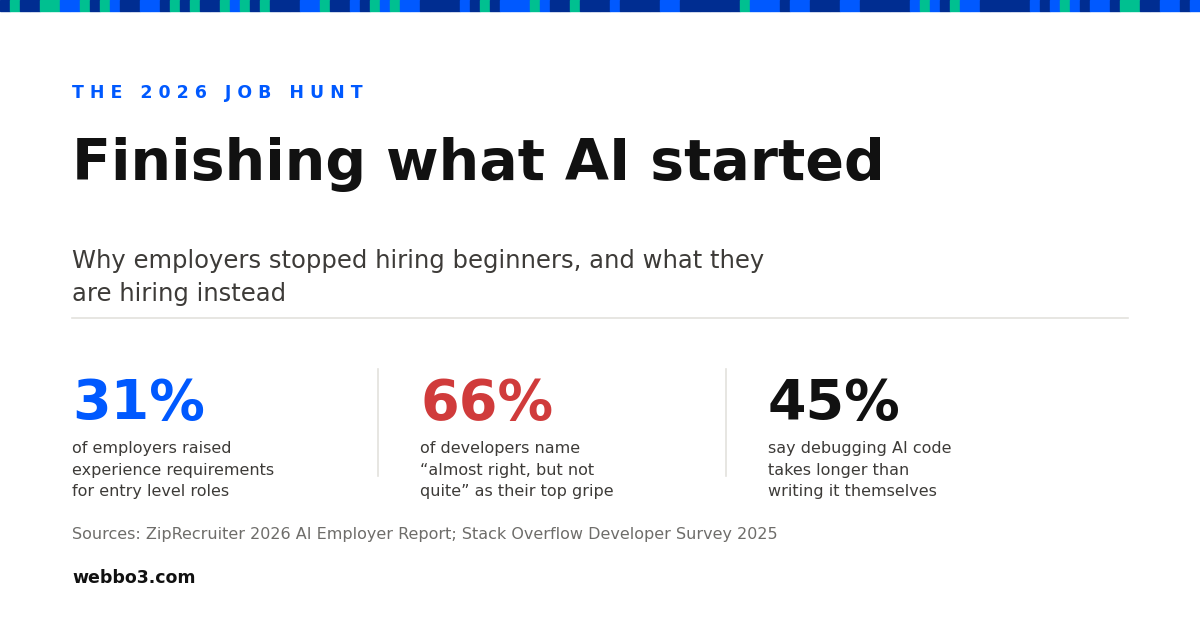
Most people pick a tech career from the same short list: frontend developer, data analyst, UI/UX designer, cybersecurity. Those are good careers. They are also where everybody else is standing, which is why a junior frontend opening can pull in hundreds of applications in a week.
Here is what almost nobody tells beginners. A lot of the jobs that hire fastest in 2026 are ones you rarely hear about. They sit inside a bigger system (a CRM like Salesforce, a cloud bill, a bank's mainframe, a new regulation) and exist because that system needs people who understand it. Fewer people train for them, so the queue is shorter, and a good portfolio stands out much faster.
This guide lists 40 of them. For each one you get what the job actually is, why it still pays, and a short roadmap to get there. Before the list, a quick look at the numbers, and one honest caveat.
What the data says about 2026
- The overall market is still growing. The World Economic Forum's Future of Jobs Report 2025 expects 170 million new roles and 92 million displaced by 2030: a net gain of 78 million. Its fastest growing roles by percentage are big data specialists, fintech engineers, AI and machine learning specialists, software developers and security management specialists.
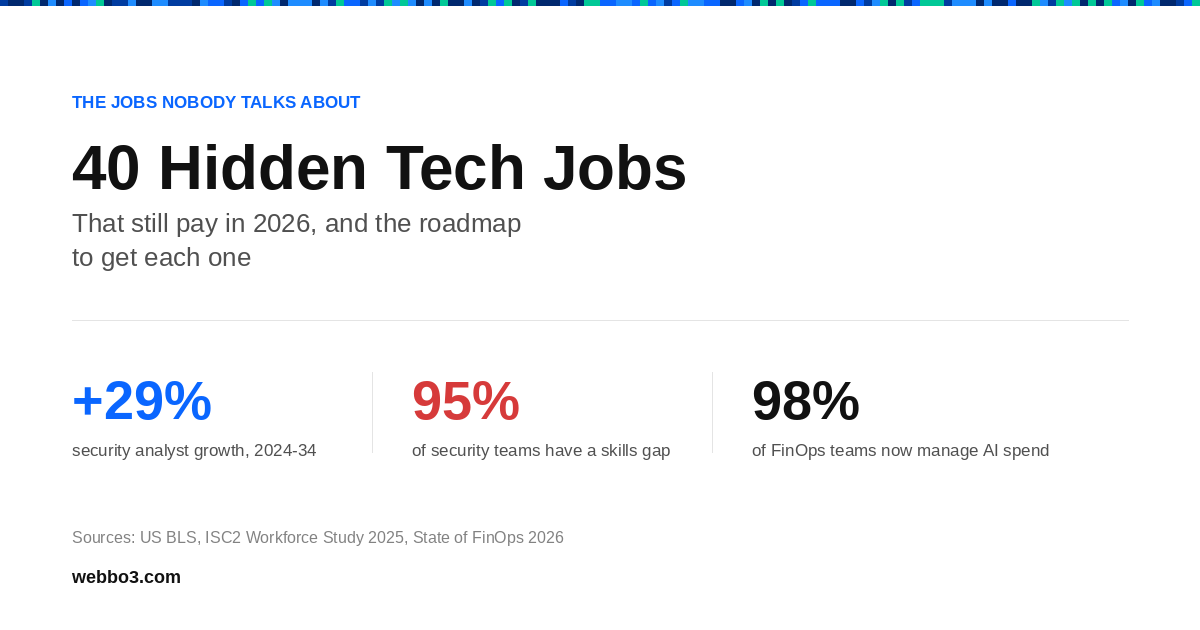
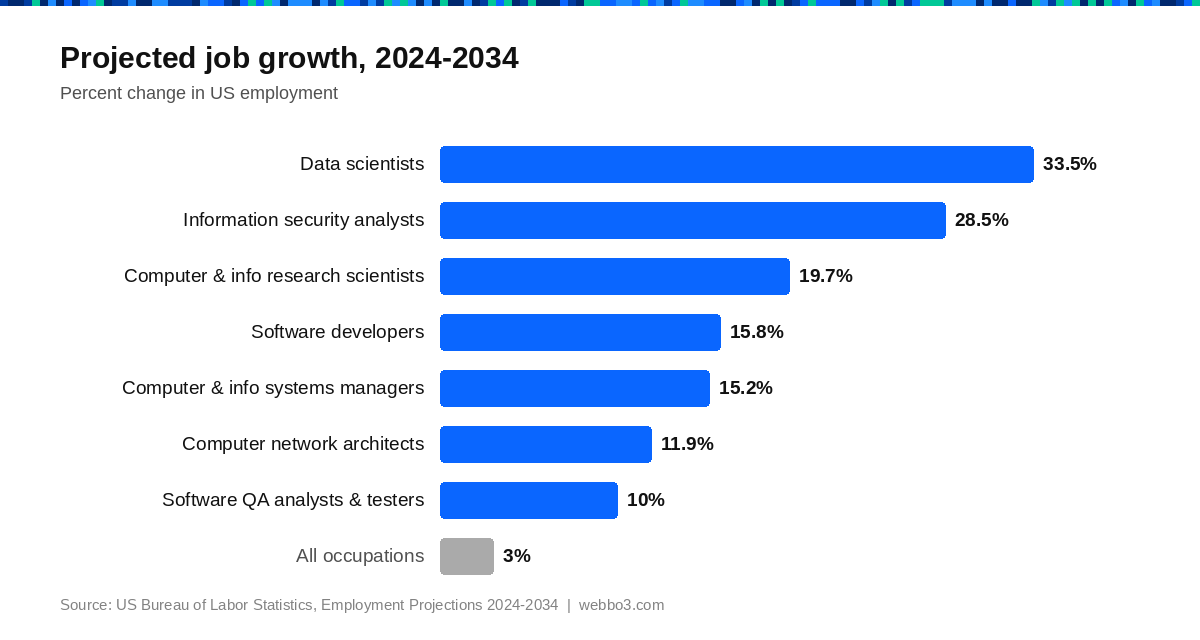
- Tech still grows faster than everything else. The US Bureau of Labor Statistics projects information security analysts to grow 29% from 2024 to 2034, against 3% for all jobs. Its newer 2025-2035 projections put data scientists at 35% growth, with about 280,000 computer and IT openings every year.
- The shortage is now a skills shortage, not a headcount one. In the 2025 ISC2 Cybersecurity Workforce Study (16,029 respondents), 95% of security teams reported at least one skills gap, and 59% called those gaps critical or significant, up from 44% a year earlier.
- New spending creates new jobs. The FinOps Foundation's State of FinOps 2026 found that 98% of teams now manage AI spend, up from 31% two years earlier. AI cost management is the number one skills gap practitioners named.
- Regulation creates jobs too. The European Accessibility Act has been enforced across all 27 EU countries since 28 June 2025. Every company selling digital products into Europe now needs people who can test and fix accessibility.
The honest caveat
Nobody can promise you a job, and you should be wary of anyone who does. What these 40 roles offer is better odds: more demand than trained people, and hiring managers who care more about proof you can do the work than about your degree. Every roadmap below ends with the same thing for that reason: build a portfolio that proves it. Two or three real, documented projects beat ten certificates.
A tip that applies to all 40: look for the jobs where the tools live. Salesforce, ServiceNow, SAP and Microsoft all run partner directories. The companies listed there hire for these roles constantly, and far fewer people apply to them than to open postings on LinkedIn.
Security jobs beyond "cybersecurity analyst"
1. GRC Analyst (Governance, Risk and Compliance)
You make sure a company follows security standards like ISO 27001, SOC 2, PCI DSS or Nigeria's NDPA. It involves more documents than code, which is exactly why fewer technical people choose it. Every fintech that wants a bank partner or foreign investor needs this work done.
Roadmap:
- Learn security basics with ISC2's free Certified in Cybersecurity (CC) course.
- Study one framework deeply: ISO 27001 or SOC 2.
- Portfolio: write a full risk register, access control policy and gap assessment for an imaginary fintech.
- Add CompTIA Security+ or ISO 27001 Lead Implementer when you can afford it.
- Apply to fintechs, audit firms and compliance-automation companies like Vanta and Drata customers.
2. Identity and Access Management (IAM) Engineer
You control who can log in to what. Most breaches start with a stolen or over-powered account, so companies pay well for people who can run single sign-on, multi-factor authentication and access reviews properly.
Roadmap:
- Learn how SAML, OAuth 2.0 and OpenID Connect work.
- Get free developer tenants from Okta and Microsoft Entra ID and practise.
- Portfolio: set up SSO for three demo apps, enforce MFA and document a joiner, mover and leaver process.
- Take Microsoft SC-300 or an Okta certification.
- Apply to IT teams at banks, telcos and managed security providers.
3. OT / ICS Security Analyst
You protect the computers that run factories, power grids, oil facilities and water plants. The skill set mixes IT security with industrial engineering, and very few people have both. Engineers from those industries who learn security are especially valuable.
Roadmap:
- Learn networking and security basics (CompTIA Network+ and Security+ level).
- Study industrial protocols like Modbus and DNP3, and the IEC 62443 standard.
- Portfolio: build a small lab with a simulated PLC (OpenPLC is free), capture its traffic and write up the weaknesses.
- Aim for GIAC GICSP or an ISA/IEC 62443 certificate.
- Target oil and gas, manufacturing, power companies and their contractors.
4. Cloud Security Engineer
Companies moved to AWS, Azure and Google Cloud faster than they learned to secure them. Misconfigured storage and over-permissive roles remain one of the most common causes of data leaks, and the people who can find and fix them are scarce.
Roadmap:
- Get one cloud foundation cert (AWS Cloud Practitioner or AZ-900).
- Learn IAM policies, network security groups, encryption and logging in that cloud.
- Portfolio: deploy a deliberately vulnerable setup (CloudGoat is free), exploit it, then fix and document it.
- Take AWS Security Specialty or Microsoft AZ-500.
- Apply to cloud consultancies and any company hiring "DevSecOps".
5. Digital Forensics and Incident Response (DFIR) Analyst
When a company gets hacked, you work out what happened, what was taken and how to stop it happening again. It is detective work with evidence, and the demand for it rises with every ransomware headline.
Roadmap:
- Learn Windows and Linux internals: processes, logs, the registry, file systems.
- Practise with free tools: Autopsy, Volatility, Velociraptor.
- Solve blue-team challenges on CyberDefenders or Blue Team Labs Online.
- Portfolio: publish three investigation write-ups with timelines and findings.
- Apply to security operations centres, incident response firms and banks.
Platform specialist jobs (the hidden goldmine)
This is the group most beginners never hear about. Big companies run on a few huge software platforms, and each platform needs its own specialists. You learn one tool deeply rather than a whole general career, and the platform's own free training usually does most of the work.
6. Salesforce Administrator or Developer
Salesforce is the CRM behind a huge share of the world's sales and customer teams. IDC forecast the wider Salesforce ecosystem would create millions of jobs by 2026, and partner companies earn several dollars for every dollar Salesforce itself makes. Admins configure it; developers extend it with Apex and Lightning components.
Roadmap:
- Create a free Trailhead account and a free developer org.
- Complete the admin trails: objects, fields, flows, reports, security.
- Portfolio: build a complete app for a real use case (a school admissions pipeline, for example) and record a walkthrough.
- Pass the Salesforce Administrator certification, then Platform Developer if you code.
- Apply to Salesforce partner consultancies, which hire remotely and in volume.
7. ServiceNow Developer or Administrator
ServiceNow runs IT help desks, HR requests and operations workflows for most large enterprises. It is invisible to ordinary users, which is why so few people train for it, and it pays accordingly.
Roadmap:
- Sign up for a free Personal Developer Instance at developer.servicenow.com.
- Learn the basics through ServiceNow's free Now Learning courses.
- Learn JavaScript, because ServiceNow scripting uses it.
- Portfolio: build an incident workflow and a custom service catalogue app.
- Pass Certified System Administrator (CSA), then Certified Application Developer (CAD).
8. SAP Consultant
SAP runs the finance, supply chain and HR of many of the world's biggest companies, including a lot of Nigerian multinationals, oil firms and FMCG companies. Many of them are migrating to SAP S/4HANA before older versions lose mainstream support, which keeps consultants busy.
Roadmap:
- Pick one module that matches your background: FICO (finance), MM (procurement), SD (sales) or SuccessFactors (HR).
- Learn it through SAP Learning Hub or the free courses on learning.sap.com.
- Understand the business process first; the software follows it.
- Portfolio: document an end-to-end process (procure to pay, for example) with screenshots from a practice system.
- Get the associate certification for your module and apply to SAP partners and big consulting firms.
9. Workday Analyst
Workday is the HR and payroll system for many global companies. It is a closed ecosystem: training is mostly available through employers and partners, so supply stays low and pay stays high.
Roadmap:
- Build HR or payroll domain knowledge first; that is the door in.
- Learn Excel and reporting to a strong level.
- Get a job in HR operations or HRIS at a company that uses Workday and volunteer for the system work.
- Portfolio: document HR process improvements you designed, with before and after numbers.
- Get certified through your employer or a Workday partner once inside.
10. Microsoft Power Platform Developer
Power Apps, Power Automate and Copilot Studio let companies build internal apps without full software teams. Almost every company already pays for Microsoft 365, so the demand is everywhere, including small and mid-sized Nigerian businesses.
Roadmap:
- Get a free Microsoft 365 developer environment or Power Apps developer plan.
- Learn Power Apps (canvas and model-driven), Power Automate and Dataverse on Microsoft Learn.
- Portfolio: replace a real paper or Excel process (leave requests, inventory) with a working app.
- Pass PL-900, then PL-200 or PL-400.
- Pitch small businesses directly as a freelancer while you apply for roles.
11. Marketing Automation Specialist (HubSpot, Klaviyo, Marketo)
Companies pay for marketing software and then use a fraction of it. You set up the email journeys, lead scoring and integrations that make it earn its keep. It sits between marketing and tech, so few people are fluent in both.
Roadmap:
- Take HubSpot Academy's free certifications (Inbound, Marketing Hub, Email Marketing).
- Learn basic HTML for email templates and how APIs and webhooks work.
- Portfolio: build a full lead-to-customer journey in a free HubSpot account and show the results.
- Add Klaviyo for e-commerce or Marketo for enterprise.
- Apply to agencies and SaaS companies, or freelance on Upwork.
12. ERP Implementer (Odoo, Zoho, Microsoft Dynamics)
Growing African businesses are moving off spreadsheets onto affordable business systems like Odoo and Zoho. Someone has to set up their inventory, accounting and sales modules, train their staff and keep it running.
Roadmap:
- Learn basic accounting and inventory concepts.
- Pick one platform; Odoo Community is free and open source, Zoho has a free tier.
- Portfolio: fully set up a demo business (a pharmacy or supermarket) and record the process.
- Take the platform's official certification.
- Join an implementation partner or sell setup packages to local SMEs.
Data jobs off the beaten path
13. Analytics Engineer
You sit between the data engineer and the analyst: you turn messy raw tables into clean, tested models that dashboards can trust. The role only became common in the last few years, so few people have it on their CV.
Roadmap:
- Get strong at SQL: joins, window functions, CTEs.
- Learn dbt (dbt Core is free) and Git.
- Learn a cloud warehouse; BigQuery has a free tier.
- Portfolio: take a public dataset, build staging and mart models with tests and documentation, and publish it on GitHub.
- Consider the dbt Analytics Engineering certification.
14. Power BI Developer
General "data analyst" roles are crowded. Power BI developers who know DAX, data modelling and Power Query properly are not, because most people stop at drag-and-drop charts.
Roadmap:
- Learn Excel and SQL basics.
- Learn Power Query, star schema modelling and DAX.
- Portfolio: three dashboards that answer real business questions, each with a short write-up of the decision it supports.
- Pass Microsoft PL-300.
- Apply to consultancies, banks and FMCG companies, which run on Power BI.
15. Data Quality Analyst
AI projects fail on bad data more than on bad models. Data quality analysts find duplicates, gaps and errors before they reach reports or models. It is quiet, unglamorous and increasingly essential.
Roadmap:
- Learn SQL and Python (pandas).
- Learn data profiling and validation tools like Great Expectations.
- Portfolio: audit a messy public dataset, list every issue, fix it and write the rules that would catch it next time.
- Learn the basics of data governance (the DAMA-DMBOK framework).
- Apply to banks, telcos, insurers and healthcare companies.
16. GIS Analyst
Geographic Information Systems turn location data into decisions: where to put a new branch, how to route deliveries, where flooding will hit. Logistics, agriculture, telecom, oil and government all need it, and few tech learners even know it exists.
Roadmap:
- Learn QGIS, which is free, through its official tutorials.
- Learn spatial concepts: projections, layers, raster and vector data.
- Add Python (GeoPandas) and spatial SQL (PostGIS).
- Portfolio: map a real Nigerian problem (flood risk in Lagos, clinic access in a state) using open data.
- Consider an Esri ArcGIS certification for corporate jobs.
17. Health Informatics Analyst
Hospitals and health tech startups are digitising records, and they need people who understand both data and clinical workflows. Nurses, pharmacists and lab scientists who learn data have a big head start here.
Roadmap:
- Learn SQL and a BI tool.
- Learn health data standards: HL7 FHIR and ICD-10 coding.
- Learn health data privacy rules (NDPA, and HIPAA for US employers).
- Portfolio: analyse a public health dataset and build a dashboard a hospital manager would actually use.
- Apply to health tech startups, HMOs, NGOs and hospital groups.
18. Product Analyst
You measure how people use an app: where they drop off, what makes them pay, which feature actually worked. Tech companies prize this because it directly drives revenue.
Roadmap:
- Learn SQL and basic statistics, especially A/B testing.
- Learn event analytics tools: Mixpanel, Amplitude or PostHog (all have free tiers).
- Portfolio: set up tracking on a small app you built, then write a funnel and retention analysis.
- Learn to write product recommendations, not just charts.
- Apply to fintechs and SaaS startups.
AI jobs that did not exist three years ago
19. AI Evaluation Specialist
Companies building on AI need people who test whether the model's answers are correct, safe and useful, and who design the tests that catch failures before customers do. It rewards careful thinking more than heavy maths.
Roadmap:
- Learn how large language models work and how they fail (hallucination, bias, prompt injection).
- Learn Python and an evaluation framework such as promptfoo or OpenAI Evals.
- Portfolio: build an evaluation set of 100 test cases for a chatbot in a domain you know, score it and publish the findings.
- Add domain expertise (law, finance, health) for higher pay.
- Apply to AI startups and AI training platforms.
20. AI Governance and Risk Analyst
New rules like the EU AI Act, and standards like ISO/IEC 42001 and the NIST AI Risk Management Framework, mean companies must document and control how they use AI. The EU recently moved some high-risk deadlines to 2027 and 2028, but companies are building their teams now.
Roadmap:
- Learn AI basics and GRC basics (see job 1).
- Study the EU AI Act, NIST AI RMF and ISO/IEC 42001.
- Portfolio: write an AI risk assessment and model documentation for a real AI product.
- Take the IAPP AIGP certification.
- Apply to consulting firms, banks and large tech companies.
21. MLOps Engineer
Plenty of people can train a model in a notebook. Very few can deploy it, monitor it and keep it working in production. That gap is the MLOps job.
Roadmap:
- Learn Python, Git, Docker and Linux.
- Learn basic machine learning with scikit-learn.
- Learn MLflow, a model-serving tool like FastAPI, and one cloud ML platform.
- Portfolio: take one model from training to a monitored, automatically retrained API with a CI/CD pipeline.
- Learn Kubernetes basics as you grow.
22. AI Automation Specialist
You connect AI models to a business's real tools so work happens automatically: invoices processed, leads qualified, support tickets drafted. Small and mid-sized companies want this badly and cannot afford a full engineering team.
Roadmap:
- Learn n8n (open source), Make or Zapier.
- Learn how APIs, webhooks and JSON work.
- Learn to call AI models through their APIs and write structured prompts.
- Portfolio: automate three real workflows and show the hours saved.
- Sell fixed-price automation packages to local businesses while applying for roles.
23. Domain Expert AI Trainer
AI labs pay professionals (accountants, doctors, lawyers, engineers, coders) to write and grade the answers models learn from. Pay rises sharply with expertise, and much of the work is remote.
Roadmap:
- Be strong in one field; your degree or work history is the asset.
- Practise writing clear, step-by-step explanations and spotting subtle errors.
- Apply to platforms that recruit expert contributors, and read their guidelines carefully.
- Build a track record on quality scores, then move into reviewer and lead roles.
- Use the experience to move into AI evaluation (job 19).
Cloud and infrastructure jobs
24. FinOps Analyst
You help companies stop wasting money on cloud and AI. With 98% of FinOps teams now managing AI spend, the role has moved from nice to have to essential, and it suits people with a finance or accounting background.
Roadmap:
- Learn cloud basics on AWS or Azure.
- Learn how cloud and AI are billed: instances, storage, tokens, reserved capacity.
- Take the FinOps Certified Practitioner exam from the FinOps Foundation.
- Portfolio: analyse a sample cloud bill, find the savings and present them like a report to a CFO.
- Apply to cloud-heavy startups and consultancies.
25. Site Reliability Engineer (SRE)
SREs keep websites and apps running. When a bank app goes down, every minute costs money, so companies pay well for people who prevent outages and fix them fast.
Roadmap:
- Learn Linux, networking and one scripting language (Python or Bash).
- Learn monitoring with Prometheus and Grafana.
- Learn Docker, Kubernetes and Terraform.
- Portfolio: run a small app with dashboards, alerts and a written incident post-mortem.
- Read Google's free SRE book and apply to fintechs and telcos.
26. Platform Engineer
You build the internal tools that let a company's developers ship code safely and quickly. It is where DevOps grew up, and good platform engineers are hard to find.
Roadmap:
- Master Git, Linux and one programming language.
- Learn CI/CD with GitHub Actions or GitLab CI.
- Learn Kubernetes and infrastructure as code with Terraform.
- Portfolio: build a template that lets a new service go from code to production with one command.
- Take the Certified Kubernetes Administrator (CKA) exam.
27. Database Administrator (PostgreSQL)
Everyone wants to be a data scientist; far fewer people want to keep the database itself fast, backed up and secure. PostgreSQL has become the default for new applications, and experienced administrators are scarce.
Roadmap:
- Learn SQL deeply, then PostgreSQL internals: indexes, query plans, vacuum.
- Learn backup, restore, replication and monitoring.
- Portfolio: set up a replicated database, simulate a failure, recover it and document every step.
- Learn cloud databases (Amazon RDS, Azure Database for PostgreSQL).
- Apply to banks, fintechs and hosting companies.
28. Mainframe / COBOL Developer
Banks, insurers and governments still run core systems on mainframes, many written in COBOL. The people who built them are retiring, and universities mostly stopped teaching it. That is a supply gap you can step into.
Roadmap:
- Start with IBM Z Xplore, IBM's free hands-on mainframe learning platform.
- Learn COBOL, JCL and the basics of CICS and DB2.
- Portfolio: build and document a small batch program that processes transaction files.
- Earn the IBM Z Xplore badges.
- Apply to banks, insurers and IT service firms that support them, many of which hire and train juniors.
29. Network Automation Engineer
Networks used to be configured by hand, one device at a time. Now they are managed with code. Engineers who know both networking and Python are rare and valued by telcos and ISPs.
Roadmap:
- Learn networking to CCNA level.
- Learn Python, then Ansible and Netmiko for network automation.
- Practise in free labs like Cisco's DevNet sandboxes or GNS3.
- Portfolio: script a configuration backup and change for a simulated multi-device network.
- Take Cisco's automation certification track and apply to telcos, ISPs and data centres.
Quality, documentation and customer-facing tech jobs
30. QA Automation Engineer
Manual testing is getting crowded; testers who write automated test suites are not. As teams ship faster with AI-written code, someone has to prove the code actually works.
Roadmap:
- Learn testing fundamentals: test cases, bug reports, test levels.
- Learn JavaScript or Python.
- Learn Playwright or Cypress for web, and Postman for APIs.
- Portfolio: a public repo with an automated test suite for a real website, running in GitHub Actions.
- Consider ISTQB Foundation. Webbo3 Academy's Software Testing course covers the fundamentals.
31. Accessibility Specialist
You make websites and apps usable for people with disabilities. Since the European Accessibility Act took effect, any company selling digital products in Europe must comply, and automated scanners only catch a fraction of issues. Manual testers who understand WCAG are in demand.
Roadmap:
- Learn HTML and CSS properly, including semantic HTML.
- Study WCAG 2.2 and ARIA.
- Learn to test with a screen reader (NVDA is free) and keyboard only.
- Portfolio: audit three real websites, write reports and show the fixes in code.
- Take the IAAP CPACC or WAS certification.
32. Technical Writer (API and Developer Docs)
Every software product needs documentation, and developer tools live or die by it. Writers who can read code and explain APIs clearly are rare, and many roles are fully remote.
Roadmap:
- Learn to write clearly and plainly (Google's free Technical Writing courses are a good start).
- Learn basic programming, Git, Markdown and how REST APIs work.
- Learn a docs tool like Docusaurus or MkDocs.
- Portfolio: rewrite the docs of an open-source project and get the changes merged.
- Apply to SaaS, fintech and developer tool companies.
33. Technical Support Engineer (Tier 2 and 3)
Not the phone-answering kind. You debug real customer problems using logs, APIs and databases. It is one of the most reliable entry routes into SaaS companies, and many engineers started here.
Roadmap:
- Learn Linux, networking basics, SQL and how HTTP and APIs work.
- Learn to read logs and use Postman and browser developer tools.
- Portfolio: write troubleshooting guides for common problems in a tool you know well.
- Practise clear written communication; support is judged on it.
- Apply to SaaS companies hiring remote support engineers across time zones.
34. Solutions Engineer (Sales Engineer)
You explain and demonstrate a technical product to customers, and design how it fits their systems. Few engineers enjoy selling and few salespeople understand code, so people who can do both are paid very well, often with commission on top.
Roadmap:
- Build solid technical basics: APIs, cloud, one programming language.
- Practise presenting and explaining technical ideas simply.
- Portfolio: record product demo videos and write integration guides for a real API product.
- Start in support or implementation (job 35) to learn the customer side.
- Apply to B2B SaaS, cloud and fintech infrastructure companies.
35. Implementation Specialist
When a company buys software, someone has to set it up, move the old data over and train staff. Implementation specialists do that. It needs organisation and technical comfort more than deep coding.
Roadmap:
- Learn spreadsheets, SQL basics and data migration concepts (CSV imports, field mapping).
- Learn basic project management (the free Google Project Management course is a good start).
- Pick one product category, such as HR, payroll, accounting or school management software.
- Portfolio: a documented implementation plan and data migration for a demo customer.
- Apply to SaaS companies with onboarding or customer success teams.
Specialist builder jobs
36. Payments Integration Engineer
Every African business that sells online needs payments that work: Paystack, Flutterwave, Stripe, bank transfers, webhooks, refunds, reconciliation. Developers who understand payments properly are scarce, and the WEF lists fintech engineers among the fastest growing roles in the world.
Roadmap:
- Learn a backend language (JavaScript with Node.js, or Python).
- Learn how payment flows work: authorisation, webhooks, idempotency, refunds.
- Use the free test modes of Paystack, Flutterwave and Stripe.
- Portfolio: build a checkout with subscriptions, failed payment handling and a reconciliation report.
- Apply to fintechs, e-commerce companies and agencies.
37. Smart Contract Auditor
Blockchain projects lose huge sums to bugs in their code. Auditors find those bugs before attackers do. Public audit contests pay by results, so a beginner with real skill can earn and build a reputation without a CV.
Roadmap:
- Learn Solidity and how the Ethereum Virtual Machine works.
- Study known attacks: reentrancy, oracle manipulation, access control mistakes.
- Practise on Ethernaut and Damn Vulnerable DeFi.
- Enter contests on Code4rena, Sherlock or Cantina.
- Portfolio: your public findings are your portfolio.
38. Shopify Developer
Millions of stores run on Shopify, and many need custom themes, apps and integrations. It is a focused skill with a steady stream of freelance and agency work, much of it paid in dollars.
Roadmap:
- Learn HTML, CSS and JavaScript. Webbo3 Academy's Frontend Development course covers this foundation.
- Learn Shopify's Liquid templating and theme architecture.
- Join the free Shopify Partner programme and create development stores.
- Portfolio: build a custom theme and one small app or integration.
- Find clients on Upwork, the Shopify Partner directory and through agencies.
39. Embedded / IoT Developer
Smart meters, solar inverters, trackers and medical devices all run code on small chips. Africa's growing solar and energy sector needs this skill, and very few bootcamps teach it.
Roadmap:
- Learn C and basic electronics.
- Start with Arduino, then ESP32 for Wi-Fi projects.
- Learn communication protocols: I2C, SPI, UART, MQTT.
- Portfolio: build a device that reads a sensor and sends data to a live online dashboard.
- Apply to energy, agritech, telecom and hardware startups.
40. Technical SEO Specialist
Most SEO work is content. Technical SEO is fixing why a site is not being found at all: crawl errors, slow pages, broken structured data, JavaScript that search engines cannot read. It needs web development knowledge, which most marketers lack.
Roadmap:
- Learn HTML, CSS and how browsers and search engines render pages.
- Learn Google Search Console, Screaming Frog and Core Web Vitals.
- Learn structured data (schema.org) and sitemaps.
- Portfolio: audit a real site, fix the issues and show the traffic change over time.
- Apply to agencies, e-commerce and media companies, or freelance.
How to choose one of the 40
Forty options can freeze you, so use three questions:
- What do you already know? An accountant should look at FinOps, SAP FICO or GRC. A nurse at health informatics. An engineer at OT security or embedded. Your old career is a head start, not a waste.
- Do you prefer building, fixing or explaining? Builders suit platform and payments work. Fixers suit SRE, DFIR and QA. Explainers suit technical writing, solutions engineering and implementation.
- What can you practise for free today? Almost every roadmap above starts with a free tool or free training. Start there before paying for anything.
Then commit to one for six months. People who switch every few weeks end up with ten beginner skills and no portfolio. People who go deep on one niche end up being the obvious hire.
Frequently Asked Questions
Which of these jobs is easiest to get into without a degree?
Platform roles like Salesforce administrator, Power Platform developer and marketing automation specialist are the most degree-friendly. The platforms offer free training, their certifications are respected, and hiring managers mostly care whether you can configure the system. A strong portfolio and one certification often matter more than a degree for these roles.
Can I get these jobs remotely from Nigeria?
Many of them, yes. Technical writing, QA automation, Salesforce, Shopify development, AI evaluation and technical support are commonly hired remotely. Security and infrastructure roles are more often local or hybrid because of data rules. Build your portfolio in public on GitHub or LinkedIn so remote employers can see your work.
How long does it take to get job-ready?
For most roles on this list, expect six to twelve months of consistent practice, around ten to fifteen hours a week. Platform roles can be faster. Security, SRE and mainframe roles usually take longer. The biggest factor is not talent but consistency and finishing real projects.
Do I need to know coding for all of them?
No. GRC, implementation, FinOps, Workday and marketing automation need little or no coding. Others, like MLOps, payments and embedded development, are coding-heavy. Even for the low-code roles, basic SQL and an understanding of how APIs work will set you apart.
Where to go from here
Webbo3 Academy runs live online classes taught by real instructors, with AI-guided lessons in between, and every course ends in portfolio projects you can show an employer. If one of these paths starts with data, frontend or testing, the next step is to see the courses and what the first week covers. You can also register to get started.
Sources: World Economic Forum, Future of Jobs Report 2025. US Bureau of Labor Statistics, Employment Projections 2024-2034 and 2025-2035. ISC2, 2025 Cybersecurity Workforce Study. FinOps Foundation, State of FinOps 2026. IDC, The Salesforce Economic Impact. European Commission, European Accessibility Act (Directive (EU) 2019/882) and AI Act.