Here is the thing almost nobody says out loud about looking for work in 2026.
You can finish a course. You can build three projects. You can learn the language, the framework, the tools. And you can still send out sixty applications and hear nothing back, not because you are bad, but because the job you trained for is not the job being advertised any more.
The old deal was simple. A company hired a beginner, gave them the small repetitive work, and let them learn the business while doing it. That work was the training. That work is now done by a machine.
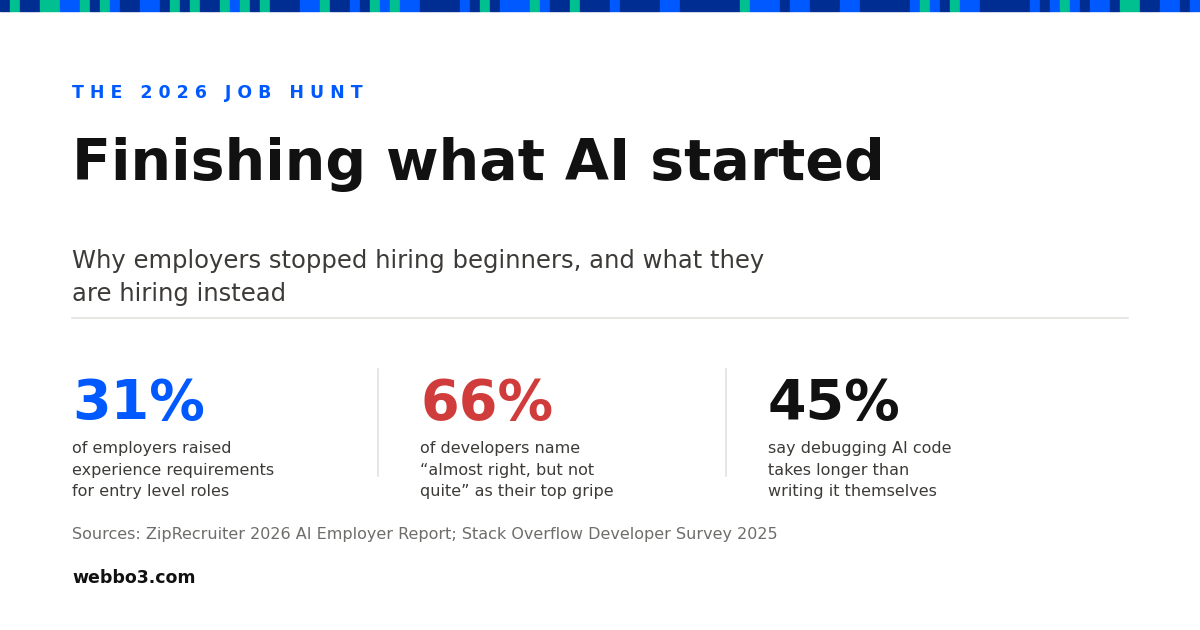
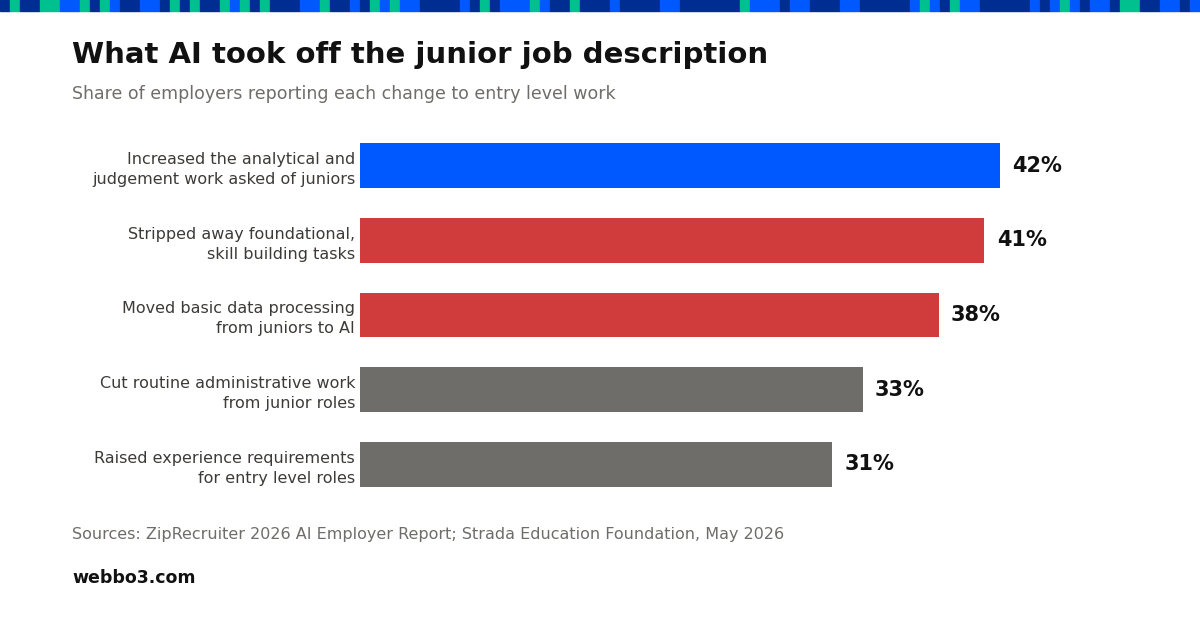
ZipRecruiter surveyed more than a thousand hiring managers in June 2026. Thirty eight percent said they have moved basic data processing away from entry level workers and given it to AI. Thirty one percent said they have raised the experience requirement for entry level roles. Read that again: entry level roles now require experience. That is not a contradiction the employers are embarrassed about. It is the new normal.
So if you are applying as someone who "can do the job", you are applying for a job that mostly no longer exists in that shape. What does exist, in growing numbers, is something different: the job of taking what an AI has already produced and making it actually good.
That is what this article is about. What changed, why it changed, why creativity is now the scarce thing rather than the soft thing, and ten real jobs built entirely around finishing what AI started.
The bottom rung got removed, not lowered
The Strada Education Foundation asked nearly 1,500 executives and senior talent leaders the same kind of question in May 2026, and got a picture that fits exactly.
Forty one percent said AI has stripped away the foundational, skill building tasks juniors used to do. Forty two percent said the analytical and judgement work asked of juniors has gone up. In tech specifically, that second number rises to sixty percent.
Put those two findings side by side and you have the whole problem in one sentence: the easy work that used to teach you the job is gone, and the hard work that used to come after two years is now day one.
This is why job hunting feels unfair right now. It genuinely is a harder entry than it was three years ago, and the difficulty is not a reflection of you. But it is not a closed door either, and the same surveys say why.
The demand did not disappear. It moved. Nearly 2.7 times more employers expect entry level hiring to increase in 2026 than expect it to fall. Thirty five percent of employers expect AI to grow their total headcount. They are hiring. They are just hiring for a different shape of person.
AI is intelligent. It is not creative.
This distinction matters more than any tool you could learn this month, so it is worth being precise about it.
A language model produces its output by predicting what most plausibly comes next, based on an enormous amount of material that already existed before you asked. That is not an insult. It is the mechanism. It is genuinely intelligent in the sense that it can reason across a huge amount of accumulated human knowledge faster than any person alive.
But look at what that mechanism can and cannot do.
It can give you the average of everything that has been written about your problem. It cannot know that your particular client hates the word "seamless", that this feature quietly breaks for users on 2G, that the tone of the average LinkedIn post is exactly the tone your audience is tired of, or that the "standard" solution was already tried at your company last year and failed.
Averages are useful. Averages are also, by definition, unremarkable. When everyone in your market can generate the average answer in four seconds for free, the average answer stops being worth money. What becomes worth money is the specific answer: the version that fits this business, this user, this constraint, this moment.
Getting from the average to the specific is a creative act. It requires taste, context, judgement and the willingness to disagree with a confident machine. That is the skill being bought in 2026.
Employers have already said this, plainly, in their own rankings. In the Strada survey, executives rated critical thinking and communication at 4.3 out of 5 in importance for entry level hires. They rated AI literacy last, at 3.6. ZipRecruiter's top five desired skills came out as critical thinking (65%), workflow automation (60%), data analysis (60%), judgement and decision making (59%) and creativity (58%).
Notice the pattern. Four of those five are about deciding, not producing. Knowing how to prompt a model is now assumed, the way knowing how to use email is assumed. Knowing whether the output is any good is the job.
The 20% that AI cannot finish
If you want to see the size of this gap, look at software, where AI adoption went furthest fastest and the receipts are public.
Stack Overflow surveyed more than 49,000 developers across 177 countries. Eighty four percent use AI tools. Only twenty nine percent say they trust the accuracy of what comes out, down eleven points in a year. Just three percent say they highly trust AI generated code. Seventy five percent manually review every AI generated snippet before merging it.
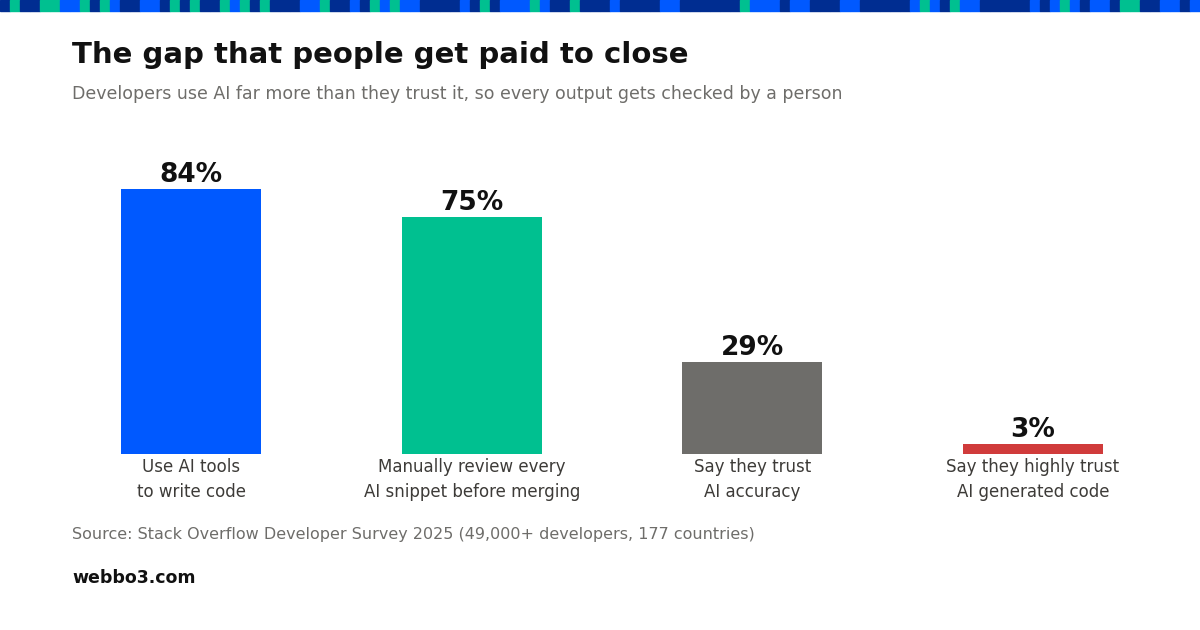
The single most common complaint, from sixty six percent of them, is not that AI is useless. It is that AI produces work that is "almost right, but not quite". Forty five percent say debugging AI generated code now takes longer than writing it themselves would have.
"Almost right, but not quite" is the most important phrase in the 2026 labour market. It describes the AI blog post, the AI design, the AI financial model, the AI customer reply and the AI lesson plan just as well as it describes AI code.
Almost right is worthless in production. Almost right is what gets a company sued, embarrassed, or quietly abandoned by its customers. The distance between almost right and actually right is small in words and enormous in value, and closing it is not a task you can hand back to the thing that produced the error in the first place.
That gap is now a job market. And the market has noticed: job postings requiring experience with AI coding tools rose 340% between January 2025 and January 2026, while postings for pure implementation roles fell 17%.
Ten jobs that exist because AI cannot finish its own work
These are not speculative. Every one of them is being advertised right now, and several of them did not exist as a job title three years ago.
1. AI content editor
The clearest example of the shift. Marketing teams stopped posting for "blog writer" and started posting for an editor who briefs the model, checks every fact, rewrites for a voice a machine cannot hold, and personally owns whether the piece is publishable. On ZipRecruiter, AI content editing roles commonly pay between $27 and $42 an hour. What makes you good at it is not writing speed. It is having an opinion about what is boring.
2. AI code reviewer or verification engineer
Somebody has to be the person who reads the generated pull request and says no. Given that 43% of AI generated code changes need debugging in production, and developers now spend roughly 38% of the working week on verification and debugging, this is not a niche. It is becoming the senior developer's main job. You need to read code far better than you need to type it.
3. Software tester and QA specialist
More code is being produced by fewer people, faster, with less understanding of it. Every one of those lines still has to be proven to work. Testing is structurally protected here for a reason that never goes away: you cannot let the system that produced the error be the only thing that checks for it. It is also the shortest honest route into tech from zero, which is exactly why we built a free 5 day software testing course.
4. AI output evaluator (model response grader)
Companies pay people to grade AI responses against a rubric: correct or not, safe or not, on brand or not, escalated when it should have been. Postings ask for things like adjudicating disputed calls between reviewers. This is remote friendly, open to non engineers, and very often the first paid AI job people get. It is also a genuine education, because you spend all day looking at exactly how AI fails.
5. AI auditor and algorithm auditor
As the EU AI Act phases in through 2024 to 2026, organisations using higher risk AI systems are required to keep human oversight, bias testing and technical documentation. Auditors check where training data came from, test outputs for bias, and document model behaviour for regulators. Compliance work is not glamorous and it does not get cut, because the alternative is a fine.
6. AI workflow and automation builder
Workflow automation was the second most in demand skill in ZipRecruiter's survey at 60%. The role is the person who connects the model to the actual business: chaining tools with something like n8n, Make or Zapier, deciding where a human must approve, and building the fallback for when the model fails. Nobody is born knowing a company's process. This is where domain knowledge from any previous career becomes an advantage, not baggage.
7. Data annotation and labelling QA lead
Models learn from labelled data, and the quality ceiling of the model is the quality of that labelling. Beyond the labelling itself, there is a supervisory layer: writing the guidelines, resolving disagreements between annotators, auditing samples. Nigeria, Kenya and South Africa already have deep pools of this work, and the QA layer above it pays considerably better than the labelling.
8. AI assisted designer and creative director
Generated images are instantly recognisable as generated, which is precisely the problem for a brand. The work is direction and correction: art directing the model, fixing the hands and the type, enforcing a brand system across output that has no memory of your brand, and knowing when the generated option should be thrown away. The AI removed the execution time. It did not supply the taste.
9. Technical writer and documentation editor
AI drafts documentation enthusiastically and confidently describes functions that do not exist. The editor's job is to check the draft against the actual system, cut the padding, and make it usable by a real person who is stuck at 2am. Anyone who has ever followed bad documentation understands the value immediately.
10. Customer support escalation and conversation design
Bots now handle the easy tier of support. What reaches a human is, by definition, only the hard cases: the angry, the ambiguous, the ones where the bot already gave a wrong answer that must now be walked back. Alongside it sits conversation design, the job of rewriting the flows so the bot fails less often next week. This is a genuine communication job, and communication was rated 4.3 out of 5 by employers.
Look at the list as a whole and one thing stands out. Not one of these jobs is "produce the first draft". Every one of them is judge, correct, contextualise, decide, own. That is the shape of work now.
How to get one of these when you have no experience
The honest problem remains: employers want experience, and you cannot get experience without a job. But the specific experience they want here is unusually easy to manufacture for yourself, because the raw material is free.
Build a before and after portfolio. This is the single highest leverage thing you can do this month. Take a real task. Get the AI output. Then fix it, and document what you changed and why. Three pieces, showing the AI version and your version side by side, with your reasoning in between, proves the exact skill being hired for. A certificate proves you attended something. This proves you have judgement.
Get specific, not general. Generic ability is the thing AI is best at, so competing on generic ability is competing on its home ground. Depth in one domain, insurance claims, church media, agricultural supply chains, secondary school exams, is what lets you spot the error a generalist model cannot see.
Use AI in a way that builds you rather than replaces you. Using it to produce your answers while you are learning prevents the learning, and it prevents it invisibly. Using it to explain things, to draft something you then critique, and to be checked by you, builds precisely the calibration skill the job requires.
Learn to test. Whatever field you are in, the verification skill is the one rising in value across all of them.
Stop applying as a beginner. Not as a lie, but as a reframing. "I am learning frontend development" is a description of a student. "I take AI generated interfaces and make them accessible, responsive and on brand, here are three before and afters" is a description of someone with a function. Same person, same skills, entirely different application.
If you are job hunting from Nigeria
Two things are true here at once, and both are worth planning around.
The first is that this shift is mostly good news for Nigerian job seekers. These roles are disproportionately remote and disproportionately judged on demonstrated output rather than on which university you attended. Remote AI work is currently growing faster than locally contracted roles, and platforms hiring evaluators, annotators and reviewers across Nigeria, Kenya and South Africa are a real doorway in.
The second is that the pay gap between local and remote is large enough to shape your strategy deliberately. Entry level analyst work at a Nigerian company typically runs between ₦150,000 and ₦600,000 a month, while equivalent remote entry level work with international employers sits around $1,000 to $2,500 a month. Within two or three years, remote mid level data and ML contracts commonly reach $2,000 to $5,000 a month.
The practical route most people take is to use local or freelance work to build the evidence, then use the evidence to reach the remote market. What makes that jump possible is a portfolio of work someone can verify without meeting you.
What I would tell you if you were sitting across from me
You are not imagining the difficulty. The bottom of the ladder was genuinely removed while you were climbing towards it, and being told to "just learn AI" while everyone is learning AI is not useful advice.
But the reason this is happening is also the reason there is a way through. AI got extremely good at producing plausible work and remains bad at knowing whether the work is right, appropriate, honest or interesting for one specific situation. That is not a temporary bug that the next model release quietly fixes. Knowing whether something is right for a particular business, in a particular market, for particular people, requires being in that context. The model is not there. You are.
So stop trying to be faster than the machine at producing things. Become the person who decides whether what it produced is good enough, and can prove it. That job is being advertised right now, and it is being advertised more every month.
Common questions
Is it still worth learning to code in 2026?
Yes, but learn it as a reading and judging skill as much as a writing one. Eighty four percent of developers use AI to generate code and only three percent highly trust the result. The person who can tell working code from plausible looking code is the one the whole workflow depends on.
Are entry level jobs really disappearing?
Entry level tasks are disappearing. Entry level hiring is not: 2.7 times more employers expect increases than decreases for 2026. What has changed is that the role now starts with judgement work that used to arrive in year two.
Do I need to become an AI engineer to benefit from this?
No, and the survey data argues against it. Employers rated AI literacy the least important of the skills they assessed, and critical thinking and communication the most important. The roles in the list above are mostly editorial, analytical and quality roles, not model building roles.
Will these AI checking jobs also be automated soon?
The checking layer is the most structurally protected part, because the reason it exists is that the model's own confidence cannot be trusted. A system cannot be the sole verifier of its own output, and where regulation applies, the EU AI Act explicitly requires human oversight for higher risk systems.
How long does it take to get ready for one of these roles?
For the evaluation, testing and QA end, a few focused months is realistic, which is why testing keeps coming up as the fastest honest entry. For editing and review roles in a field you already know, you may be closer than you think, because your existing domain knowledge is the scarce half.
Where these numbers come from
- ZipRecruiter, 2026 AI Employer Report. Survey of 1,000+ talent acquisition professionals and hiring managers, June 2026. Source of the 38% data processing shift, 31% raised experience requirements, 92% AI adoption, 35% headcount growth and the top five desired skills.
- Strada Education Foundation, Entry-Level Hiring in the AI Era. Nearly 1,500 executives and senior talent leaders, May 2026. Source of the 41% and 42% task shift figures, the 2.7x hiring expectation, and the skill importance ratings.
- Stack Overflow Developer Survey 2025. 49,000+ developers across 177 countries. Source of the 84% adoption, 29% trust, 3% high trust, 75% manual review, 66% "almost right, but not quite" and 45% debugging figures.
- Sonar, State of Code Developer Survey 2026. Verification and debugging time share, and production debugging rates for AI generated changes.
- EU AI Act. Human oversight, documentation and testing obligations for higher risk systems, phasing in through 2024 to 2026.
- ALX Africa, AI Jobs in Africa 2026. Local and remote pay ranges for African AI and data roles.
Where to go from here
Webbo3 Academy runs live online classes with real instructors, and AI guided lessons in between, built around the skills this article argues are now the ones being bought: building real things, testing them properly, reviewing work critically, and being able to explain your reasoning. If that is the direction you want to move in, look at the course structure and what the first week covers, or register to get started.
If you want the fastest honest entry point, start with the free 5 day software testing course. Verification is the skill this whole shift is built on.