There are two numbers about tech work that both appear to be true, and they point in opposite directions.
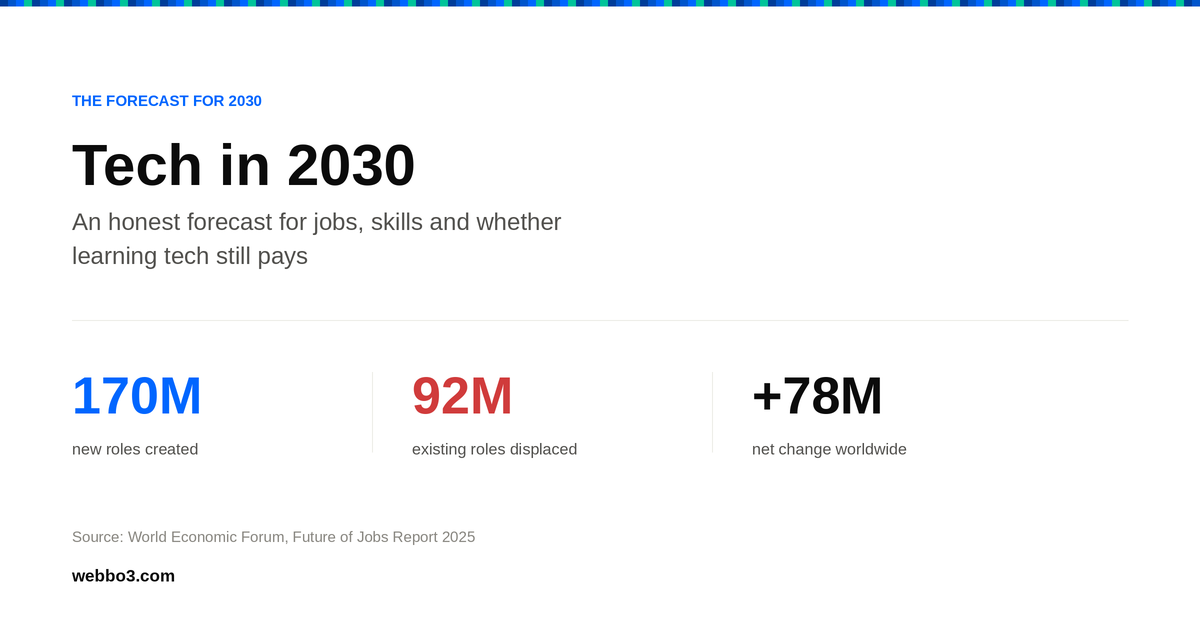
The first: the World Economic Forum surveyed over a thousand large employers and found that the three fastest-growing skills between now and 2030 are AI and big data, networks and cybersecurity, and plain technological literacy. On their numbers, the world adds 170 million new roles and loses 92 million by 2030, a net gain of 78 million jobs.
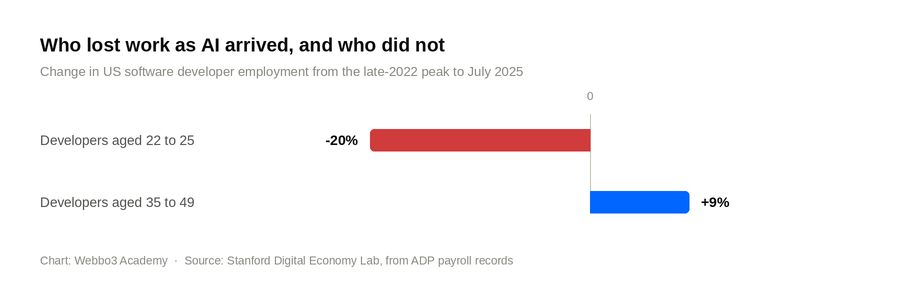
The second: Stanford's Digital Economy Lab looked at actual payroll records rather than employer opinions, and found that employment for software developers aged 22 to 25 fell by roughly 20% from its late-2022 peak. Over the same period, employment for developers aged 35 to 49 rose about 9%. Entry-level hiring at large tech firms dropped 25% year on year in 2024. Tech internship postings are down about 30% since 2023.
So: tech skills have never been more in demand, and it has rarely been harder to get a first tech job. Both statements are correct. Most articles about 2030 pick one of them and pretend the other does not exist.
This piece is an attempt to hold both at once, and to say plainly what I think that means for someone deciding, right now, whether to spend the next two years learning this.
What the forecasts actually say
Start with the projections, because they are the part people quote and rarely read.
The WEF Future of Jobs Report 2025 puts job churn at 22% of all jobs by 2030. Roughly 39% of the skills a worker needs today will have changed by then. Among employers, 86% expect AI and information processing to transform their business by 2030; 85% plan to upskill their workforce; 70% plan to hire people with new skills; 73% plan to automate more processes. The single biggest barrier those employers name to transforming their business is the skills gap, and 63% of them say so.
In percentage terms, the fastest-growing roles they name are big data specialists, fintech engineers, and AI and machine learning specialists, with software and application developers fourth and security management specialists fifth. AI and data processing specifically are projected to create about 11 million jobs while eliminating about 9 million.
The fastest-shrinking roles are not mysterious. Postal service clerks fall by about 40%, bank tellers by 35%, data entry clerks by 34%. In absolute numbers the largest losses are clerical and secretarial: cashiers, ticket clerks, administrative assistants. Graphic designers have recently joined that list, which should tell you something about how quickly a "creative" job can become an automatable one.
The US Bureau of Labor Statistics runs a different kind of exercise, building occupational projections from industry models rather than employer surveys, and its 2024 to 2034 projections line up better than you might expect.
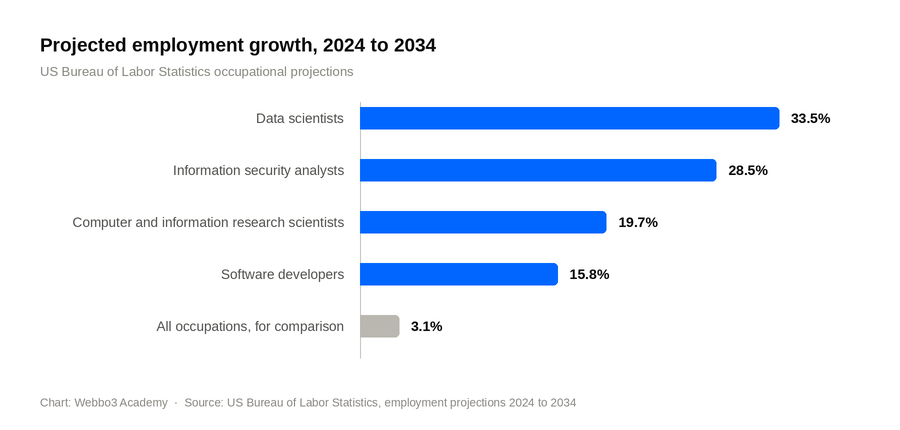
- Data scientists: +33.5%, about 82,500 new jobs
- Information security analysts: +28.5%, about 52,100 new jobs
- Computer and information research scientists: +19.7%
- Software developers: +15.8%, about 267,700 new jobs
Against a projected 3.1% growth for all occupations combined. Meanwhile the roles BLS marks as declining under AI pressure are customer service representatives (down 5.5%, about 153,700 positions), procurement clerks (down 8.7%), credit checkers (down 6.2%) and legal secretaries (down 5.8%).
Read those two lists side by side and the pattern is not "AI takes tech jobs." It is narrower and more useful than that: AI is absorbing well-specified, repeatable, procedural work, wherever that work happens to live. A clerk's job and a junior developer's job have more in common, from an automation point of view, than a junior developer's job has with a senior one.
The part the forecasts do not show you
Projections describe the shape of demand in 2030. They do not describe the road to get there, and the road is where people are currently getting hurt.
Stanford's work, by the economists Erik Brynjolfsson, Bharat Chandar and Ruyu Chen, uses ADP payroll data covering millions of workers. It found the damage concentrated almost entirely in the youngest cohort. For the most AI-exposed occupations, employment fell about 6% for 22 to 25 year olds while rising about 9% for 35 to 49 year olds. When a company adopts generative AI tools, junior headcount tends to fall 9 to 10% within six quarters. Senior headcount barely moves.
The supporting numbers are worse than the headline. Computer science graduates in the US now face about 6.1% unemployment and computer engineering graduates about 7.5%, among the highest of any major, and higher than several liberal arts degrees. Around 70% of hiring managers say AI can already do intern-level work. Entry-level postings routinely ask for two to five years of experience, at the same time as the internships that used to supply that experience have thinned out.
That is the actual crisis, and it deserves a plain name: the ladder lost its bottom rung. Not the ladder. The bottom rung.
(A caveat worth holding onto: most of this hard employment data is American. Nigeria and the rest of Africa do not have payroll datasets of that quality, so we are inferring. The direction almost certainly transfers, because the hiring companies are often the same companies. The magnitude may not.)
The five rules I think will govern tech work in 2030
Everything above is evidence. What follows is prediction, argued from that evidence, and you are free to disagree with it.
Rule 1: You will be paid for judgement, not for typing
Gartner's view is that within about three years, many organisations will have AI agents writing the majority of their software, with developers moving into review and direction roles. They also estimate that generative AI will require 80% of the engineering workforce to upskill through 2027.
Take that seriously and the job description inverts. Producing a working function stops being the valuable act, because a machine does it in four seconds. The valuable acts become: deciding what should be built, specifying it precisely enough that a machine cannot misunderstand it, and being able to tell, quickly and reliably, whether what came back is correct.
That third one is the sleeper. Reviewing code you did not write, and catching the plausible-looking mistake, is a harder skill than writing code. It is also a skill that only develops by having written a great deal of code yourself. Which produces the uncomfortable paradox of this decade: you still have to learn to do the thing that the machine will do for you, or you cannot supervise the machine.
Rule 2: The entry point stops being "junior" and becomes "has already shipped something"
If a company can get intern-level output from a subscription, the only reason to hire a beginner is that the beginner is already past intern level. Harsh, but that is what the internship and entry-level numbers are saying.
So the door does not close. It moves. The person who gets hired in 2030 with no formal experience will be the person who can point at three things that exist, that other people use, that they can explain the trade-offs of. Not a certificate. Not a tutorial repository. Something real, with a URL.
We have written separately about what kind of projects actually do this work, and the standard is going up, not down. In 2020 a to-do app was acceptable evidence. In 2030 it will be evidence of nothing, because a to-do app is now a two-minute prompt.
Rule 3: Verification becomes a career, not a chore
Here is the prediction I hold most strongly, and it is the one I see fewest people making.
When machines generate most of the output, the bottleneck moves to checking the output. Every system that produces work at scale eventually creates a matching industry of people who confirm the work is right. That is what auditors are to accounting, and what inspectors are to construction. Software has never had that at scale, because humans wrote the code slowly enough to review it as they went.
That changes when a team ships ten times more code with the same number of people. Testing, quality assurance, data validation, security review and observability go from being the unglamorous end of the profession to being the part that cannot be automated away, because you cannot ask the system that made the mistake to be the only thing checking for it.
The security numbers already point this way. The global cybersecurity workforce gap is around 4.8 million unfilled roles against an active workforce of roughly 5.5 million, according to ISC2. The field would need to grow about 87% to close it. Security management specialists were fifth on the WEF's fastest-growing list, and information security analysts are the fastest-growing computer occupation in the BLS projections at 28.5%.
If you want the least crowded path into tech in 2030, I think it is here: not building, but proving. It is also, not coincidentally, the shortest road in. You can learn to test software competently in far less time than you can learn to architect it, which is why we run a free five-day software testing course.
Rule 4: The T-shape wins, and the narrow specialist gets squeezed
The advice for the last fifteen years was to specialise: pick a lane, go deep, be the React person or the Django person. I think that advice ages badly.
The reason is mechanical. AI collapses the cost of working outside your specialty, so that a backend engineer who could never write CSS can now produce acceptable CSS. The premium for being merely competent in a second area therefore falls towards zero, while the premium for being genuinely deep in one area holds, because depth is what lets you judge the machine's output rather than just accept it.
The shape that survives is one deep thing and broad literacy everywhere else: you go deep enough in one domain to have real opinions, and you are fluent enough across the rest to build a whole system without waiting for four other people. Employers will hire fewer, broader, more senior people, which is precisely what the age data already shows happening.
Rule 5: Your employer stops being local, and so does your competition
The good news for anyone reading this from Lagos, Accra or Nairobi is that distributed hiring is now normal, and the cost differential is real. The bad news is symmetrical: the person competing for that role is not in your city either.
This cuts against the comfortable version of the remote-work story. "Companies will hire from Africa because it is cheaper" was a 2021 argument, and it is weakening. If a company's alternative to a cheap junior is not an expensive junior but no junior at all, price stops being the winning argument. What replaces it is proof of quality: a track record they can verify without meeting you. We go into the practical mechanics of this in our guide to getting a remote tech job from Africa.
What this means specifically in Nigeria
Nigeria has been running one of the most ambitious digital skills programmes anywhere. The federal 3 Million Technical Talent (3MTT) initiative, launched in late 2023, aims to train three million Nigerians by 2027. Its first application window drew over a million registrations against an initial target of 30,000. Three cohorts in, it has trained roughly 135,000 fellows directly and reached several hundred thousand more through community learning.
And yet the most-read Nigerian tech-media headline about the programme is some version of: 135,000 people trained, so why are tech jobs still this hard to get?
The answer is not that the training is bad. It is that training and hiring are two different markets, and only one of them has been scaled. Supply of trained beginners has risen very fast. Demand for untested beginners has, on the evidence above, fallen. When those two curves move in opposite directions, credentials stop being a differentiator, because everyone has one.
What differentiates in that market is evidence. Not "I completed a programme" but "here is the thing I built, here is who uses it, here is the bug I found and how I proved it was a bug." That is a change in what learning has to produce, not a reason to stop learning.
So, is there still a point in learning tech?
Yes. But I want to give you the honest version rather than the reassuring one, because the reassuring one is how people end up eighteen months in and angry.
What has genuinely lost value: memorising syntax. Being able to write a loop, a fetch call, a CRUD endpoint from scratch, unaided, under exam conditions. Knowing a framework's API by heart. Producing code as the output of your day. These were real skills that people were paid real money for, and their market value is falling and will keep falling. Pretending otherwise does no one a favour.
What has gained value, sharply: being able to take a vague problem from a non-technical person and turn it into a precise specification. Reading unfamiliar code fast and judging whether it is right. Knowing why a system is slow. Knowing how it breaks and how it gets attacked. Explaining a technical trade-off in writing to someone who will never read code. Understanding a business domain deeply enough that you notice when the requirement itself is wrong.
Notice that every item on the second list requires the first list as a prerequisite. You cannot judge code you cannot read. You cannot specify a system you have never built. The foundations did not stop mattering. They stopped being the destination and went back to being the foundation, which is what they always should have been.
So the honest answer to "should I still learn tech in 2026 for a career in 2030" is: yes, if you are learning to solve problems, and no, if you are learning to type code. The second was always a worse deal than it looked. It is now a bad deal outright.
What I would actually learn between now and 2030
Concretely, if I were starting today with 2030 in mind:
1. Fundamentals that do not rot. How the web actually works: requests, responses, state, latency. How data is modelled and why the model matters. How programs fail. These have survived every framework cycle since 1995 and will survive this one, because AI tools sit on top of them rather than replacing them.
2. One lane, deep. Pick something and go far enough to have opinions other people find useful. Depth is the only thing that lets you evaluate a machine's answer instead of trusting it. Our post on choosing between frontend and backend is a reasonable place to start that decision.
3. AI as a working practice, not a topic. Not "an AI course." The daily habit of using these tools on real work and then, and this is the part almost everybody skips, systematically checking what comes back. The skill being formed is calibration: knowing where the tool is reliable and where it quietly is not.
4. Verification skills. Testing, debugging, security basics, data quality. Undervalued right now, structurally scarce by 2030, and the fastest route from beginner to employable.
5. Written English. I am not being polite. In distributed teams, the artefact of your thinking is text: the pull request description, the bug report, the design note. When a manager cannot watch you work, your writing is your work. It is the single most underrated career multiplier in remote tech, and almost nobody trains it deliberately.
6. A public trail. Something a stranger can find and verify without your permission. Every year this compounds, and every year most people postpone starting it.
What I think will be overrated, and underrated
Overrated by 2030: prompt engineering as a standalone job title, since it is becoming a basic literacy in the way that using a search engine is, and nobody has "Google Engineer" on a business card. Certificate collecting. Learning six languages instead of one properly. Chasing whichever technology is loudest this quarter. Bootcamp completion as a hiring signal in itself.
Underrated by 2030: software testing and QA. Data quality and data engineering, because models are only as good as what they are fed and most organisations' data is a mess. Security. Documentation. Deep domain knowledge in a specific industry, especially the unglamorous ones: logistics, insurance, agriculture, health records. The engineer who understands Nigerian payments infrastructure properly will out-earn the engineer who knows one more JavaScript framework, every time.
Where I might be wrong
Any 2030 forecast that does not include this section is selling something.
The WEF numbers are a survey of what about a thousand employers expect, not a measurement of what will happen. Employers have been wrong before, often confidently. The BLS projections are models with stated assumptions, and models are wrong at turning points, which is exactly what this is.
AI capability could plateau. There are real signs of diminishing returns in some areas, and Gartner itself predicts that over 40% of agentic AI projects will be cancelled by the end of 2027, largely on cost and unclear value. If that is the story, the junior squeeze is a temporary overcorrection and hiring normalises around 2028.
Or it could accelerate past my estimate, in which case some of what I have described as safe for 2030 is safe only until 2032.
The reason I still think the advice above holds is that it is robust to both. Judgement, verification, depth, communication and a visible track record are worth more in every one of those futures. Nothing on that list is a bet on AI stalling, and nothing on it is a bet on AI winning. That is the point of choosing it.
The short version
Tech work in 2030 will need more people than it does today. The projections agree on that from two independent directions. But it will need a different kind of person than 2020 did, and the transition is being paid for, right now, by beginners.
The route through is not to avoid learning tech. It is to refuse to stop at the level the machine has already reached. Learn the foundations properly, go deep in one place, get obsessive about whether things are actually correct, write clearly, and build a trail of real work in public.
That was always the better version of this career. The difference is that it used to be optional.
Frequently asked questions
Will AI replace programmers by 2030?
The evidence says no, but it is already replacing a category of task that junior programmers used to be hired to perform. BLS still projects software developer employment up 15.8% over 2024 to 2034, and data scientists up 33.5%, against 3.1% for all occupations. The roles grow; the bottom rung of the ladder is what has broken.
Is it too late to start learning to code in 2026?
No, but the finish line has moved. Reaching "can write basic code" is no longer employable on its own. Reaching "can build, test and explain a working system" still is, and that is roughly 12 to 18 months of consistent work for most people. We break down realistic timelines in how long it really takes to learn to code.
Which tech skills will be most in demand in 2030?
On the WEF's ranking, AI and big data, networks and cybersecurity, and general technological literacy are the three fastest-growing skills. On the BLS projections, the fastest-growing computer occupations are data scientists (+33.5%) and information security analysts (+28.5%). Security and data are the common thread.
Do I still need a degree to work in tech in 2030?
Formal degrees are becoming weaker signals, not stronger. Computer science graduates currently face higher unemployment than several non-technical majors. What replaces the degree as a signal is verifiable work. We covered this in detail in do you need a degree to work in tech in Africa.
What is the easiest tech role to enter now that still has a future?
On the evidence, software testing and QA. It requires less upfront study than software engineering, it is structurally hard to automate away (you cannot ask the system that produced the error to be its own only reviewer), and demand for verification rises as AI-generated output rises.
Should I learn to use AI tools or avoid them while learning?
Use them, but change what you use them for. Using AI to produce answers while you are learning prevents the learning. Using it to explain, to review your work, and to be checked by you builds exactly the calibration skill the 2030 job requires.
Where these numbers come from
- World Economic Forum, Future of Jobs Report 2025. The 170 million created and 92 million displaced figures, 22% churn, and the fastest-growing and declining roles and skills.
- US Bureau of Labor Statistics, AI, information technology and employment, 2024 to 2034. Occupational growth and decline projections.
- Stanford Digital Economy Lab. Age-cohort employment effects in AI-exposed occupations, drawn from ADP payroll data.
- Gartner, Software Engineering 2030. AI-native engineering, the 80% upskilling estimate, and the agentic project cancellation rate.
- ISC2 Cybersecurity Workforce Study. The global security workforce gap.
- 3MTT, Federal Ministry of Communications, Innovation and Digital Economy. Nigerian training programme figures.
Where to go from here
Webbo3 Academy runs live online classes taught by real instructors, with AI-guided lessons in between, built around exactly the skills this article argues will still matter in 2030: building real things, testing them properly, and being able to explain them. If this is the direction you want, the next step is to see the course structure and what the first week covers. You can also register to get started.